Where Can I Search for Fine Art by Subject
The Getty Provenance Index® contains more than 2.2 1000000 records that can exist used for a wide variety of research purposes. The enquiry examples beneath testify how the data can exist used.
For assist searching the databases, and for more data about the Project for the Study of Collecting and Provenance, see the following:
 |
Research Examples
Trace Buying
The Getty Provenance Alphabetize can be used to establish the provenance of a piece of work of fine art:
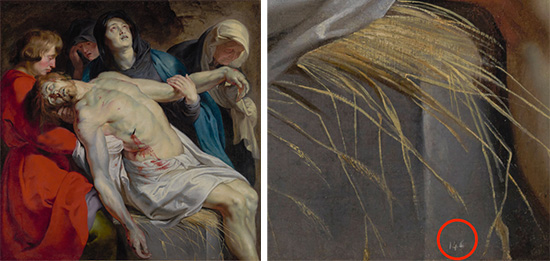
The J. Paul Getty Museum acquired The Entombment (ca. 1612) by Peter Paul Rubens in a Christie's auction in 1992. At that fourth dimension, the provenance of the painting could but be traced as far dorsum as the mid-19th century. The number 146, located on the face of the painting, appeared to be an inventory number.
A search in the Getty Provenance Index retrieved a single tape in which the creative person name (Rubens) and item number (146) matched. The search led to a 1651 inventory preserved in the Archivo de la Casa de Alba, Palacio de Liria in Madrid, which lists this Rubens painting. Perchance its first owner was Gaspar de Haro y Guzmán Carpio (1629–1687). The Getty Provenance Index provides additional data almost the collector, inventory, and related documents.
Discover Patterns and Trends
The Getty Provenance Index can also exist used to reveal a broad diversity of collecting patterns, including those related to consumer behavior, marketplace trends, dealer networks, and modes of display.
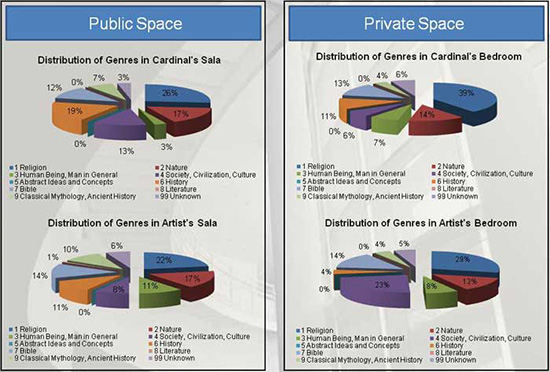
 Statistical analysis of the brandish of painting genres, based on Getty Provenance Index information (2010).
The case above analyzes patterns of display in Rome from 1550 through 1750. Nearly 300 Roman inventories comprised of 65,000 individual records were used to demonstrate whether at that place was a change in the distribution of painted subjects over time, in diverse rooms of a palace, or among different social levels of palace owners.
Past request, users can obtain a .csv export of data for apply with programs such as Excel, Access, and Filemaker, and various data visualization tools.
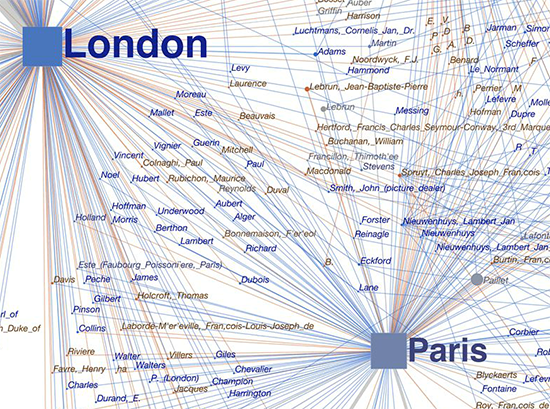
For example, the visualization (particular) below of over 230,000 Getty Provenance Alphabetize records from Belgian, British, Dutch, and French art markets reflects networks in the European auction market from 1801 to 1820.

How to Search the Getty Provenance Alphabetize
Before you begin your search, see what's currently covered in the Getty Provenance Index past land, year, and type of document.
| |
Search using original language
You must enter search terms in the original language of the document (Dutch, English, French, German, or Castilian) to recollect records. For instance, titles in French sales records must be searched in French.
Search by keywords
Enter single words in the appropriate language (run into Search using original language above). Indicate truncation on any word with an asterisk (*). Spaces between words are interpreted as "AND." For case, "entombment rubens" will remember records that contain both "entombment" and "rubens."
Search by artist or owner name
In the Artist, or Owner fields, enter a first name and/or last name in any order (e.g., Peter Paul Rubens or Peter Rubens or Rubens Peter). Do not use a comma to separate offset and concluding name. Separate multiple names with a semicolon (;). The semicolon is interpreted as the Boolean search operator "OR" then the results volition have either one creative person OR another OR both.
To search for ii artists or two owners in the same record, you can apply a combination of one of the specific name fields and the Keywords field. For example, to find a copy by Reinagle after Poussin, you would enter "reinagle" in the Artist field and "copy poussin" in the Keywords field.
Records may contain two forms of a proper name—the form that appears verbatim in the original certificate and the authorization form of the name that has been assigned by the Getty Provenance Index editors. You will get more complete results by searching for the authority form of the proper name. For instance, a search for the artist "Droogsloot" will render 428 records. When you view one of these records, you lot will see that the potency form for this proper noun is "Droochsloot." Repeating your search using the say-so spelling "Droochsloot" will return 865 records.
Search past outcome date
| Year, calendar month, and day: | yyyy mm dd (eastward.g., 1689 10 31) |
| Year and month: | yyyy mm* (e.g., 1689 10*) |
| Year: | yyyy* (e.g., 1689*) |
| Range of years: | yyyy* through yyyy* (e.chiliad., 1689* through 1710*) |
The Event Date field includes both the sale dates for auctions and the specific date for a lot or the date an object was sold (for dealer stock books).
Sale dates for auctions are limited to the first day of the sale merely. For a multiday auction, you must search the first day of the sale in order to find all of the records related to that sale. If you lot detect a lot that was sold on a subsequent twenty-four hour period of the sale and you would like to find the respective description record, yous tin can follow the direct link to the "Sale Description" at the bottom of the tape.
Search past subject
Subject terms have been assigned only to records from British 18th-century auction catalogs, German 20th-century auction catalogs, and dealer stock books, so a subject search will limit your results to those sections of the database.
You can likewise search by subject field in the Archival Inventory Contents, which uses the Iconclass system of codes and English-linguistic communication headings to draw the subjects of images represented in works of art.
Search information on 20th-century artists
The Goupil and Knoedler Stock Book records comprise some 20th-century material. Encounter a quick overview of what'southward currently covered in the databases by country, year, and type of certificate.
View a full transcription of an archival inventory
Click on "Full Transcription of the Inventory" in the Run into Also field on the full record display page.
Save search results every bit a PDF
Select the "PDF" option on the search results page.
If you lot receive an error message
Please electronic mail the error message, along with a description of what you lot did before you received information technology, to Collecting and Provenance Inquiry, and nosotros will attempt to help yous.
If you receive the message "Your search did non retrieve whatever hits"
Try broadening your search criteria and view these charts to run across what'southward currently covered in the database by country, twelvemonth, and blazon of document.
Oftentimes Asked Questions
How do I become a contributor?
Contributors generally have backgrounds in paleography, art history, or romance languages. If yous are interested in becoming a volunteer contributor to the Getty Provenance Alphabetize, please electronic mail your qualifications to Collecting and Provenance Research.
How do I evaluate the authenticity of a work of art?
Nosotros do not provide this service and recommend that you contact a qualified art appraiser or auction house.
Can you appraise a work of art I own?
We practice non provide, endorse, recommend, or guarantee appraisal services. Yet, the Getty Library does offer an Appraisals Inquiry Guide.
Who practise I contact about selling a work of art that I own?
Contact the curator of the appropriate section at the J. Paul Getty Museum. Delight include a photo and whatever information on the piece you may want to sell. The Museum will attempt to direct you lot to the appropriate dealers, museums, or auction houses for advice.
What is Iconclass?
Used past institutions effectually the world, Iconclass is the near widely accustomed classification arrangement for visual documents. Iconclass is used to index, itemize, and describe the subjects of images in paintings, drawings, photographs, and other works of fine art. Learn more than.
I believe information in a record is wrong. Who exercise I contact?
We encourage users to contact Collecting and Provenance Inquiry if they find information in whatever database that they retrieve may be incorrect. In your email, please include the tape number (which appears at the top of the record) and your source for the information to be corrected.
How exercise I obtain a copy of a sales itemize or inventory?
Photocopies of many of the documents in the Getty Provenance Index are available at the Getty Enquiry Found in the Collectors Files or the Sales Itemize Files.
Are there images of artwork in the databases?
Currently the databases do not contain images of artworks.
How do I cite the Getty Provenance Index in a publication?
Please use the following: Getty Provenance Index®. J. Paul Getty Trust
The Getty Provenance Alphabetize® is a registered trademark of the J. Paul Getty Trust.
Getty Provenance Index®, https://piprod.getty.edu/starweb/pi/servlet.starweb?path=pi/pi.web, accessed [date]. The Getty Provenance Alphabetize® is a registered trademark of the J. Paul Getty Trust.
The Getty Provenance Index® is updated regularly so it is recommended that the citation include the date of consultation, given in the ISO 8601 form (YYYY-DD-MM), east.1000., "Getty Provenance Alphabetize®, https://piprod.getty.edu/starweb/pi/servlet.starweb?path=pi/pi.spider web, accessed 2019-06-30."
Source: https://www.getty.edu/research/tools/provenance/faq.html

Post a Comment for "Where Can I Search for Fine Art by Subject"